
ARTfx BLOG
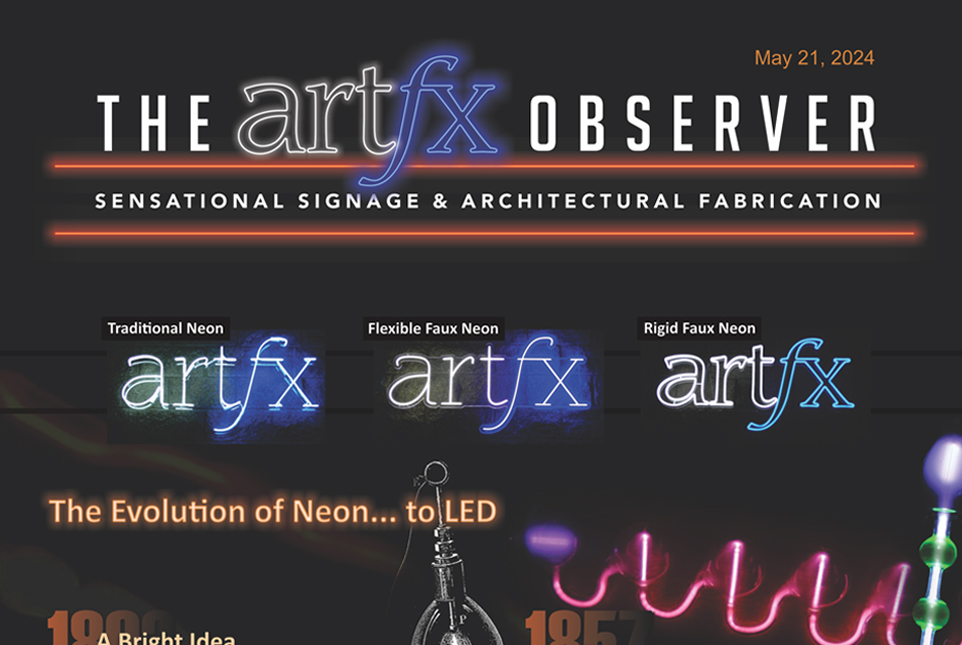
The Evolution of Neon to LED

The ARTfx Observer | May 2024
For more than a century, illuminated signs have defined the character of our streetscapes. From the buzzing glow of a corner diner to the towering spectacle of Times Square, the story of how we light up the night is one of invention, artistry, and constant reinvention.
At ARTfx, we work across every generation of this technology. Hand-bent glass neon, flexible LED neon, rigid faux neon. Each one has a place depending on the project. Here’s the story of how we got from gas-filled tubes to the signs you see today.
Three Ways to Get the Neon Look
Not all neon is created equal. Today there are three distinct technologies that produce the neon aesthetic, each with different strengths.
Traditional Neon
Hand-bent glass tubes filled with neon or argon gas. Prized for its warm, organic glow and the craftsmanship required to shape each letter by hand.
Flexible Faux Neon
LED strips in flexible silicone tubing that mimics the neon look. Lightweight, energy-efficient, and versatile for indoor and outdoor use.
Rigid Faux Neon
LEDs inside rigid acrylic or polycarbonate tubing. Durable, low-maintenance, and ideal for exterior signage where longevity matters most.
A Timeline of Light
The journey from the first electric arc lamp to modern LED signage spans more than 200 years. Here are the milestones that shaped the industry.
| 1802 | Humphry Davy demonstrates the first electric arc lamp, proving electricity can produce sustained light. |
| 1856 | Heinrich Geissler creates the Geissler tube, passing current through sealed glass filled with gas. Different gases produce different colors. |
| 1898 | William Ramsay and Morris Travers isolate neon gas for the first time. Its distinctive red-orange glow when electrified captures immediate scientific interest. |
| 1910 | Georges Claude displays the first neon lamp at the Paris Motor Show, proving neon tubes can produce brilliant light suitable for public display. |
| 1912 | Claude’s associate sells the first commercial neon sign to a Parisian barber. The era of neon advertising begins. |
| 1923 | Earle C. Anthony imports two neon signs from Paris for his Packard dealership in Los Angeles. They reportedly stop traffic. America’s love affair with neon is underway. |
| 1930s | Neon signs explode across America. Las Vegas, Times Square, and Route 66 become synonymous with the medium. Cities from coast to coast are transformed. |
| 1940s | World War II slows production, but the post-war boom brings a golden age. Diners, motels, and drive-ins compete for the most elaborate signs. The craft of neon tube bending reaches its artistic peak. |
| 1960s | Fluorescent and plastic signage begin to compete on cost and maintenance. Neon’s cultural dominance starts to fade, though it never fully disappears. |
| 1962 | Nick Holonyak Jr. invents the first practical visible-spectrum LED at General Electric. It emits a dim red light. Nobody imagines it will one day replace neon. |
| 1990s | Blue LEDs are perfected (earning their inventors a Nobel Prize), unlocking white light and the full color spectrum from solid-state components. |
| 2000s | LED signage goes mainstream. Lower energy costs, longer lifespan, and easier maintenance make LEDs the practical choice. “Faux neon” products emerge using LED strips to replicate the warm neon glow. |
| 2010s | Flexible LED neon tubing hits the market, making the neon look accessible where traditional glass would be impractical or code-prohibited. Rigid faux neon follows for even more exterior durability. |
| 2026 | Today, ARTfx works across all three technologies. The best sign shops don’t pick sides. They pick the right tool for the job. |
Why It Matters
Every project is different. A boutique hotel lobby might call for the warmth and character of hand-bent glass neon. A hospital wayfinding system needs the reliability and low maintenance of rigid faux neon. A restaurant patio sign might be the perfect fit for flexible LED neon that can handle weather and tight curves.
The point isn’t which technology is “best.” It’s knowing when to use each one. That’s what over 40 years of sign fabrication experience gives you.
Whether your project calls for the warmth of traditional neon or the efficiency of modern LED, ARTfx has the expertise to bring your vision to life.

An A+ For ARTfx

At ARTfx, we take pride in the dozens of unique signs and architectural components we’ve fabricated and installed at many well-known academic institutions. Most recently, we constructed a celebratory plaque arrangement honoring faculty and staff who have served over 25 years at The Lawrenceville School in Lawrenceville, New Jersey. Founded in 1810, the school is one of the oldest and most highly regarded preparatory schools in the United States.

Working With Experts
The newly installed dedication wall features inlaid brass, etched bronze, cut aluminum, and stained white ash. ARTfx has installed several other outstanding architectural tributes and wayfinding sign systems on The Lawrenceville School campus. Design for the project originated in the Redding, Connecticut studios of renowned graphic designer, educator, and frequent ARTfx collaborator, Alexander Isley. His work regularly features uniquely juxtaposed, dissimilar materials, often testing the boundaries of our technical abilities. However, we enjoy the challenges.


A Touch of Color

5 Considerations
2. Always aim your LED light sources into the letter, thereby creating the halo with reflected rather than direct light. This practice will also assist with light diffusion. By contrast, LEDs aimed outward often create hotspots or lighting polka dots.
3. Paint the insides of your halo-style letters a neutral white for added reflectivity. You can use white primer to save on costs. A finish coat isn’t required.
4. While much of the trade still uses 6500K white, we have moved over to 5000K for the simple reason that it falls in the mid-spectrum of available white. Therefore, the halo glows we attain appear as pure white untainted by blue overtones.
5. Use a high-quality LED. We’ve bought LEDs overseas for as little as 45 cents a foot. Trust me: the skimping will eventually bite you in the hind side. You’re going to pay the price one way or another… and you don’t want to pay with your pride, a pissed-off customer or perpetual service work.
CATERING TO THE CLIENTS NEEDS

“TRICK OF THE TRADE”

Transforming Tradition: The Yiddish Book Center’s Remarkable Renovation

For more than a decade, ARTfx has collaborated with designer, Alexander Isley, on a variety of projects at the Yiddish Book Center in Amherst, Massachusetts. Most recently, this sanctuary for Yiddish literature and art was tastefully converted into an engaging, interactive museum, including an updated theater and a recreation of the I.L. Peretz Salon.
For such a monumental undertaking, the center solicited a team of trusted experts including architect, Amy Reichert. ARTfx’s custom-fabricated displays, extensive murals, and hanging banners brought the vision to life. The work reflects more than five years of coordination between designers, architects, archivists, and preparators.
LINOTYPE DISPLAY
This 1918 Yiddish linotype press weighs 4,500 pounds and is displayed on the main floor of the center. ARTfx manufactured placards with images and copy describing the historic printing machine. (Click the image below and use the white arrows on either side to scroll.)


YIDDISH: A GLOBAL CULTURE
“Yiddish: A Global Culture” serves as the basis for the interactive exhibit distributed throughout the main floor of the renovated center. With direction from the design team, ARTfx fabricated multiple metal structures that display modern Yiddish literature, theater, music, press, and politics. Among this collection are rare books, artwork, photographs, sheet music, typewriters, and thematic memorabilia. Due to their massive size, situating the units within the space involved clever engineering. (Click the image below and use the white arrows on either side to scroll.)


The Yiddish Book Center’s exciting new updates gained immediate accolades from press outlets. The Hampshire Gazette notes, “Yiddish: A Global Culture is the most expansive exhibition the Amherst center has ever staged, a sweeping exploration of modern Yiddish literature, theater, music, politics and more that flourished from the late 19th century through the first half of the 20th century, linking communities from Warsaw to Vilna to New York to Buenos Aires.”
BOOK COVER FLAGS
Hanging banners depicting classic, well-known book covers adorn the hallway of the main floor. The pennant-style banners hang below a skylight which necessitated a specialized printing technique known as “dye sublimation.” The process allows the ink to completely permeate the fabric, protecting bright colors from intense sunlight. (Click the image below and use the white arrows on either side to scroll.)


ISAAC LIEB PERETZ SALON
I.L. Peretz was a provincial lawyer turned Hebrew and Yiddish author. The exhibit faithfully replicates his Warsaw, Poland apartment- right down to the wall treatment. For authenticity, The Yiddish Book Center consulted a specialist to recreate the specific pattern of the salon wallpaper. ARTfx vectorized the pattern for exact replication. (Click the image below and use the white arrows on either side to scroll.)


THEATER
The theater at the book center received a facelift with a fresh coat of paint and sawtooth-patterned walls. New displays showcase historical Yiddish entertainment, including political puppets from 1926. ARTfx constructed custom casing decorated with prints designed by Alexander Isley to house the puppets and assorted artifacts. (Click the image below and use the white arrows on either side to scroll.)


Bloomfield-based ARTfx Brings High-Profile Signs Nationwide
We are grateful to have been featured in many publications over the years. Recently, we stepped into the spotlight of a local news station. Please watch the video to take a peek behind the scenes.
Video Transcript, Courtesy of Fox61:
In Bloomfield. Something bright. You might not have heard of them, but it’s a good bet you’ve seen their work up in lights and center stage.
“I specialize in high-end custom electric signs and architectural fabrication.”
These are the offices of ARTfx. And before they’re affixed, the sign language starts here.
“Pepes? Absolutely. Sally’s as well.”
Graphic designs of every kind and at ARTfx, there’s no shortage of sound effects.
“It’s masonry, it’s welding, it’s woodworking. It is custom neon.”
“We’re metal fabricators, experts in plastics and lighting, you name it.”
Lawrin Rosen is the ARTfx owner. “We have craftspeople in every discipline, so we’re able to handle most of it here.”
They’ve been doing this here in Bloomfield for the past 41 years and their designs are seemingly everywhere.
“West Hartford, Hartford, Massachusetts, Rhode Island, New York.”
“You’ll see our work all over the world, all over the country.”
From high profile to higher ed. They make bold statements from a Bloomfield back-lot.
“You know, we go to art school, guys like me. We want to be artists that have our work in museums. The sign business, the whole outdoors everywhere, that’s our museum.”
“It’s always kind of cool to pass by and go, yeah, we built that.”
In Bloomfield. Jim Altman, Fox 61, Connecticut’s news station.

5 Effective Ways Signage Can Boost Your Success
In today’s complex marketplace and associated visual landscape, companies and establishments must stand out and make an impression on their potential target audience. While digital marketing and online advertising have become dominant, traditional forms of advertising, like effective signage, still play a vital role in boosting visibility and reinforcing branding. In this blog post, we discuss the significance of effective signage and list five ways effective signage can positively affect your organization’s success.
1. Capture Attention and Generating Brand Awareness
Signage acts as a silent but powerful salesperson for your business, working 24/7 to capture attention and generate brand awareness. Well-designed and strategically placed signs can easily reach a wide audience of pedestrians and motorists. A visually appealing sign that effectively represents your brand creates an immediate and indelible impact, compelling an on-site audience to take notice and remember your enterprise. When advertising, why not start with the local crowd to increase familiarity with your products or services?
2. Enhance Location Visibility
A well-executed sign strategy enhances your establishment’s visibility in a crowd. An eye-catching sign(s) with attractive colors, legible fonts, and clear messaging can attract a new audience by singling you out from competitors. Signage as a marketing form serves as a landmark, guiding people to your location and creating a strong visual presence that differentiates your communication. Effective signage will earn your organization a powerful, on-site, marketing tool, even after hours when you’re closed.
3. Establish Brand Identity and Consistency
Signage plays a crucial role in reinforcing your brand identity. Consistent use of logos, colors, and fonts sets a cohesive image which existing and potential clients recognize and associate with your establishment. Incorporating your brand’s unique personality and messaging into signage will impart a strong impression to a substantial part of your target audience. Effective signage helps build trust and loyalty, encouraging repeat business and referrals.
4. Inform and Direct Customers
Signage is an effective means of informing and directing customers by enhancing their overall experience. Whether supplying information about products, services, promotions, or simply helping to navigate through your establishment, well-designed signage can form a seamless process. Clear and concise messaging ensures that customers can easily locate what they are looking for, leading to increased purchases and overall satisfaction. Additionally, directional signs reduce confusion by guiding your audience through large buildings, campuses, shopping centers, outdoor spaces, etc.
5. Provide Long-lasting, Cost-effective Marketing
Signage is a cost-effective marketing investment that offers long-term benefits. Unlike online ads or general media promotions, signage works continuously, reaching a wide audience for an extended period. Once installed, it continues to generate brand exposure without piling on additional costs. When considering its longevity, durability, and potential reach, effective signage generates an unparalleled return on investment.
Conclusion
In an increasingly digital world, the importance of effective signage has not diminished. Investing in well-designed, strategically placed signs can significantly boost your visibility, enhance brand recognition, and drive customer engagement.
ARTfx creates powerful signage for establishments of all types and sizes. By capitalizing on the expertise of a trusted, 40-year-old, world-recognized sign company, you can elevate your establishment’s visibility while strengthening your imaging efforts, and ultimately achieve greater success in a competitive marketplace.