
ARTfx BLOG
A Quantum Leap in Lighting: Backlighting a Yale Artist’s Masterpiece
The ARTfx Observer | August 2026
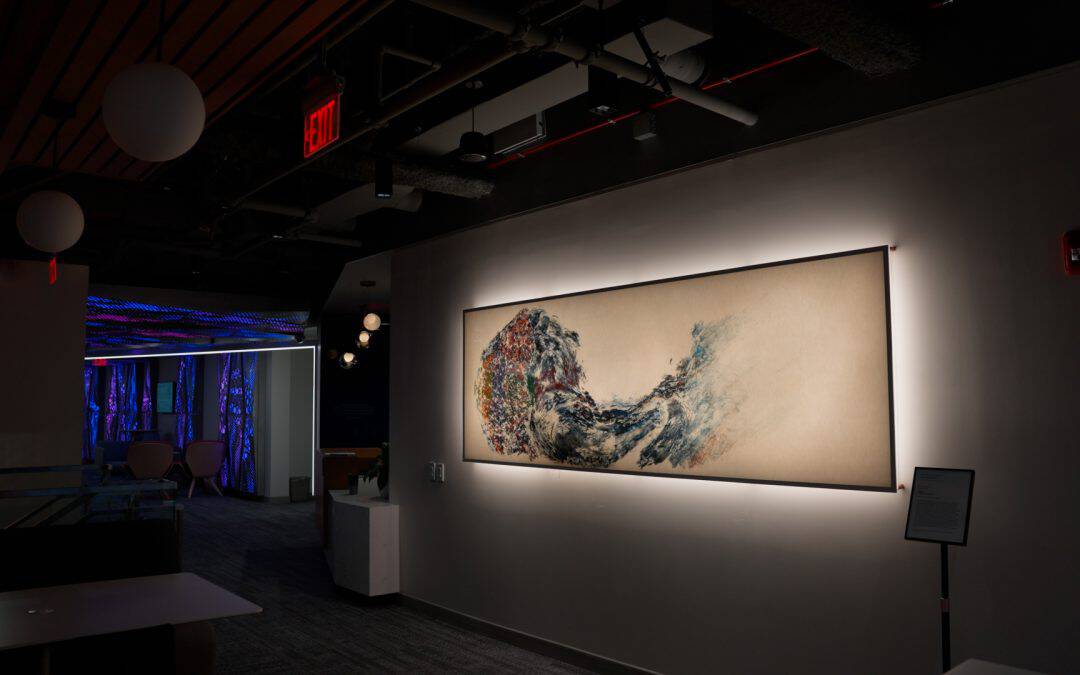
Occasionally, a project lands in our laps that has us scratching our caps. Yale’s Wu Tsai Institute needed a 33 square foot wall fixture to backlight a large-scale painting on handmade Italian paper, and the artist was flying in from Rome to finish the work in our shop. Watch how Saliency, La Memoria Cangiante came to light.
An Unusual Request
Yale’s Wu Tsai Institute, the university’s home for neuroscience and cognitive psychology, recently contacted ARTfx with an unusual request… and not for special lab equipment. They needed a 33 square foot wall fixture to backlight the work of celebrity visiting artist-in-residence, Serena Scapagnini.
Why we say, “Yes,” to these requests and what travels through the brains of ARTfx management when acquiescing, could easily become the subject of another of Serena’s compositions. However, by not saying, “No,” we inherited the complex job of backlighting the work.
The Artist and the Work
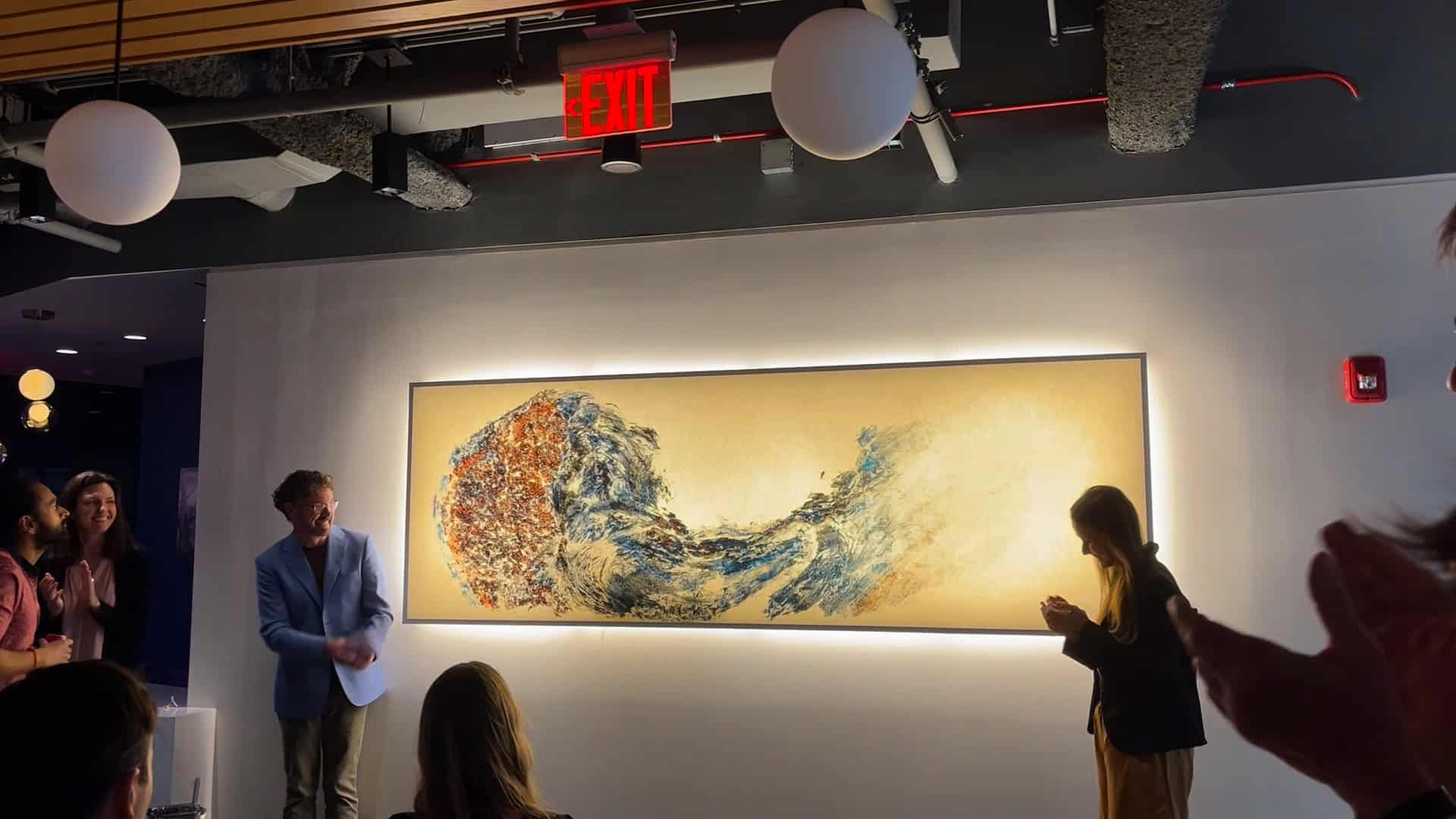
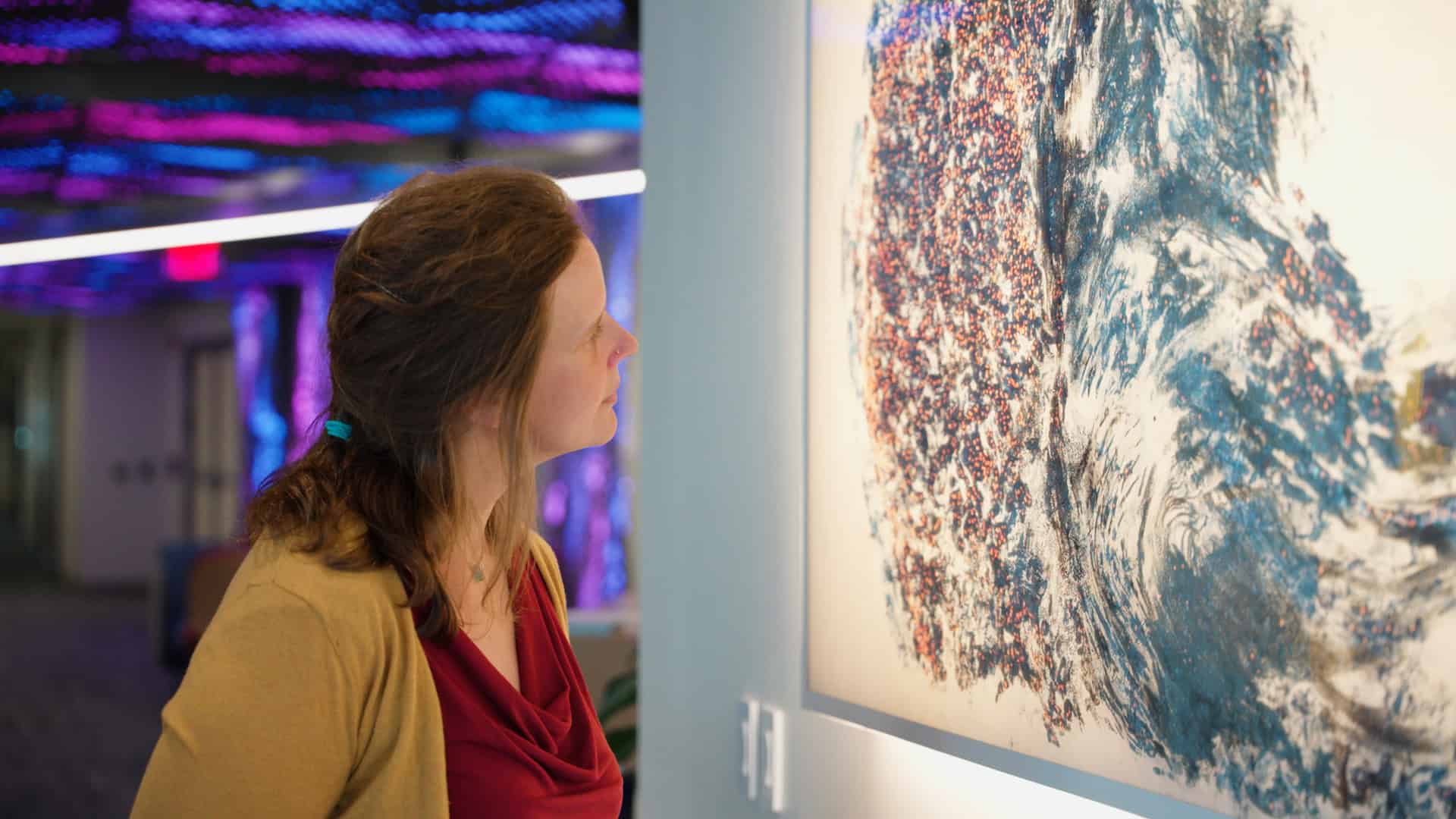
From Rome, Italy, Serena, an accomplished painter, illustrator, and art historian, was busy completing her latest piece, Saliency, La Memoria Cangiante, a large-scale, mixed media painting on handmade, imported Italian Fabriano paper. The work, conceived in dialogue with members of the scientific community at the institute, delves into the world of memory retrieval. Its composition centers around a sweeping blue wave, the artist’s visual interpretation of emanations from a brain’s coronal section and hippocampal folds.
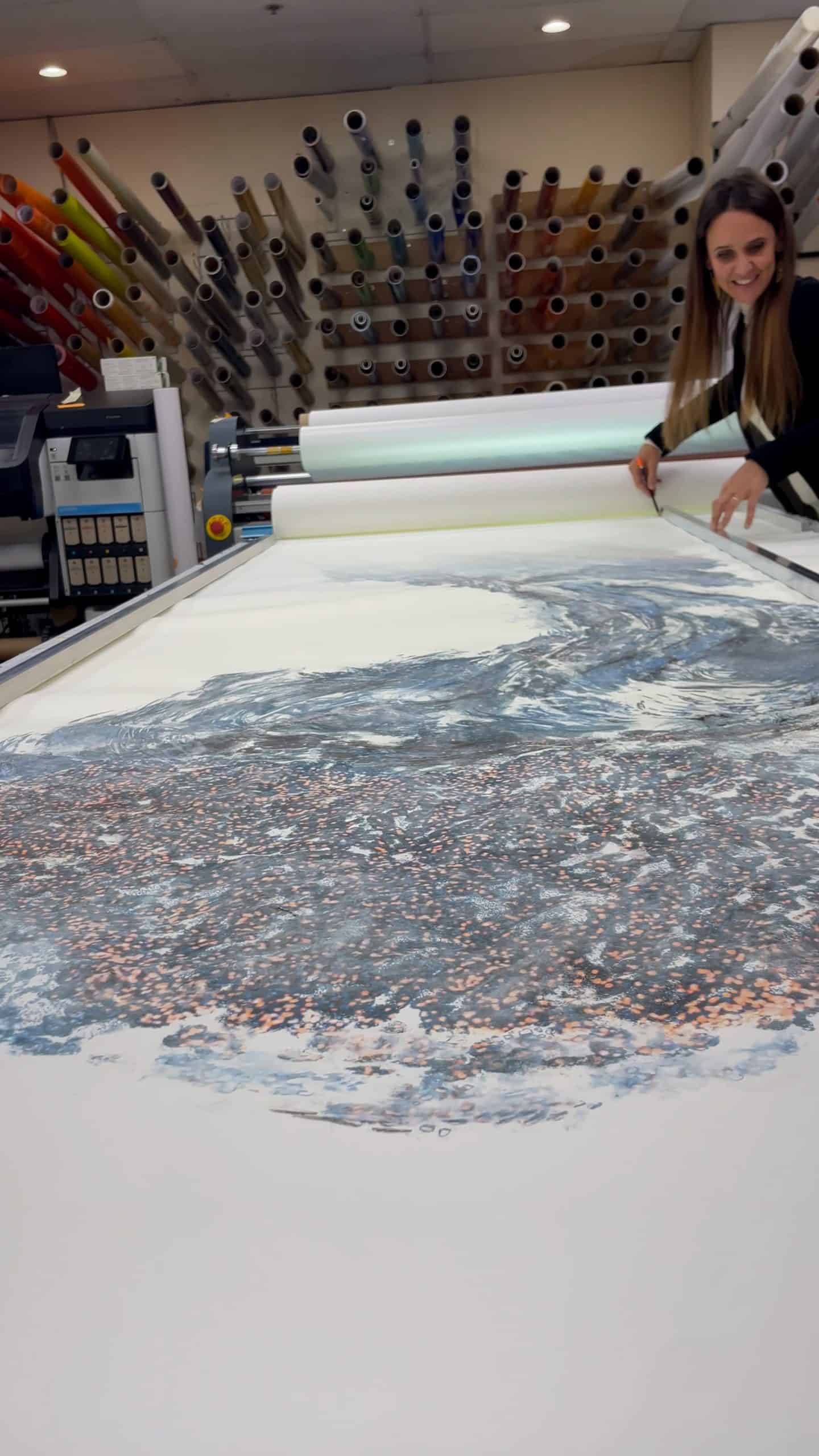
Serena worked inside the ARTfx shop to finish the piece, with our team alongside her. Drawings are hidden within the texture of the paper, meant to emerge and recede depending on how the light falls, so the paper and the fixture had to be developed together rather than one after the other.
The Complex Job of Backlighting
Handmade paper does not transmit light evenly, and Serena did not want it to. Some passages of the painting needed to glow. Others needed to sit back in shadow so the drawings buried in the texture could surface as your eye adjusted. That is a lighting problem before it is a fabrication problem.
ARTfx’ 40″ high x 9′-10″ long floating acrylic diffuser panel, packed with multiple intensities of LED modules, closely illuminates the flow of Serena’s masterpiece which now hangs prominently in the Wu Tsai Institute’s inner atrium. Multiple acrylic layers and diaphragms diffuse the light unevenly by design, so the fixture paints with light rather than simply lighting the piece from behind.
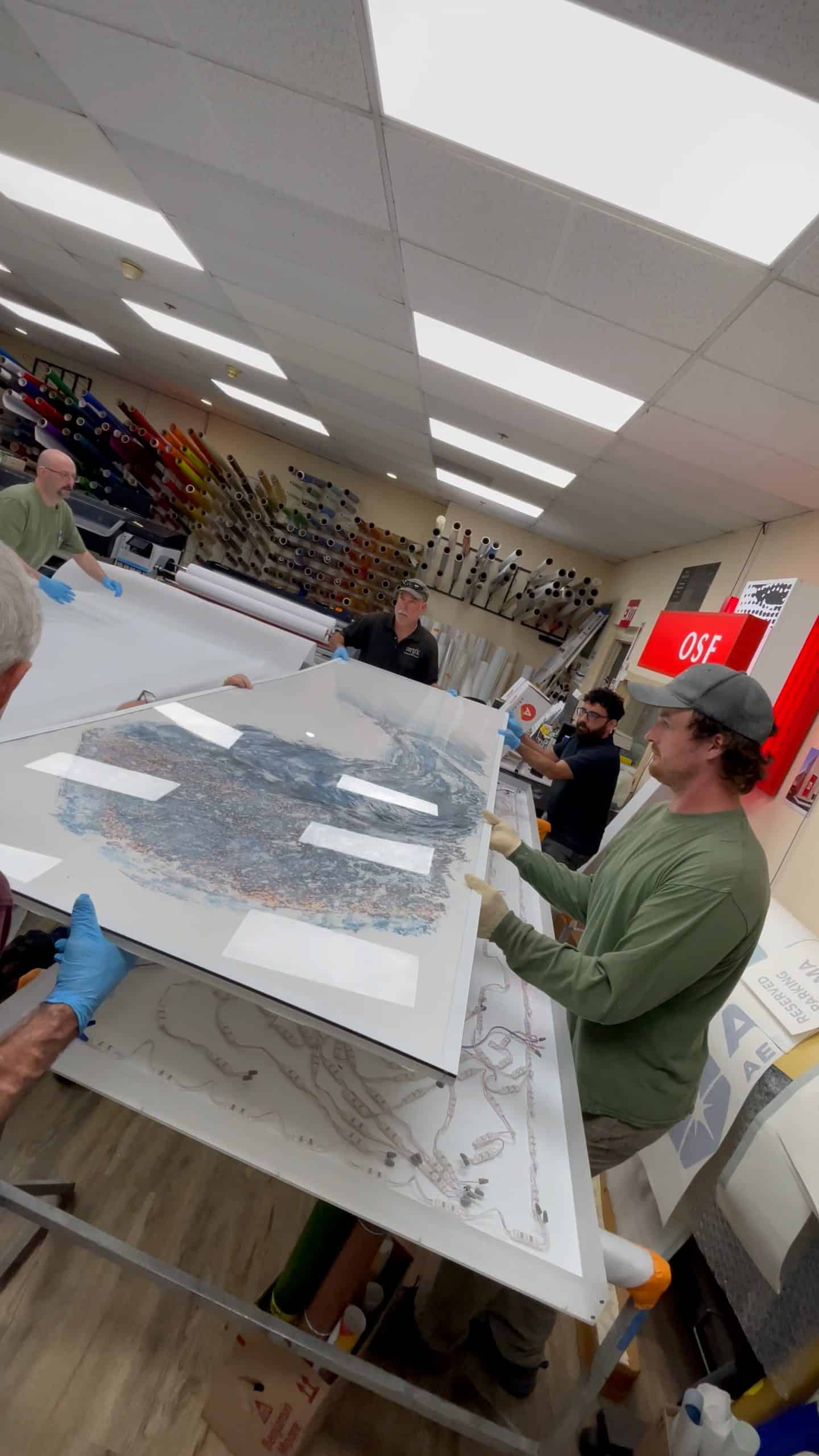
“To work with fabricators that understand art at this level allows the work to be completed by their view and suggestion, every single detail, starting from which kind of screw we want to hang on the wall. I work with incredible people that were understanding exactly what I want, what I need, and the language of the artwork itself. That was very much in good hands.”
Serena Scapagnini — Visiting Artist-in-Residence, Wu Tsai Institute, Yale University
See the Work
Project Credits
Client: Wu Tsai Institute, Yale University, New Haven, CT
Artist: Serena Scapagnini, visiting artist-in-residence
Artwork: Saliency, La Memoria Cangiante — mixed media on handmade Fabriano paper, Fabriano, Italy
Backlit Framework, Lighting & Installation: ARTfx
If you are an architect, designer, or institution with a brief that other shops call impossible, that is the work ARTfx is built for. Design, fabrication, and installation, under one roof since 1983.
Not ready yet? See why a New York art director trusts ARTfx at Lost in New Haven.

Lost in New Haven: Why a Manhattan Art Director Trusts ARTfx
The ARTfx Observer | June 2026
Robert S. Greenberg is a Rhode Island School of Design-trained artist who spent 26 years as an art director in New York City. He has worked with top-tier fabricators, and he does not hand his vision to just anyone. When he built Lost in New Haven, the immersive museum celebrating four centuries of the Elm City’s history, he needed a partner who could meet his standard. The video above is what happened when he found one.
A Designer’s Standard
Most testimonials come from happy clients. This one comes from a judge. Robert spent his career as an art director in Manhattan, working with the kind of shops that operate at the top of the trade. When he came home to New Haven and started building his museum, he tried a local sign company first. It did not work out.
Then he found ARTfx. In his words, the level of professionalism was the New York standard he was used to, and the work showed a degree of accuracy he had only seen in New York City. That is the whole point of this piece. Robert is not easy to please. His endorsement is the kind of proof that means something to the architects, designers, and museum directors who choose a fabricator on behalf of their own clients.
The Sign on the Building
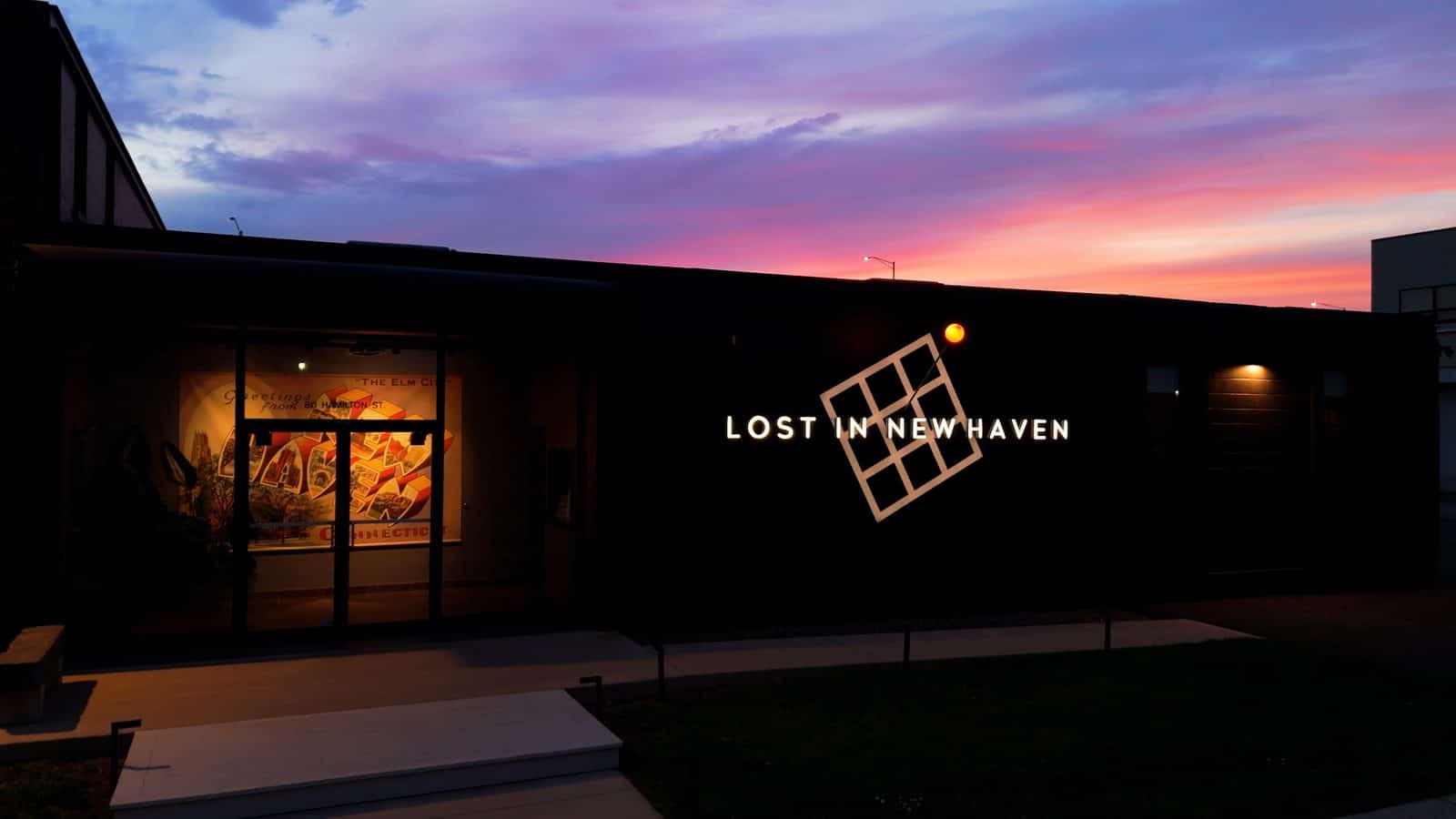
Robert came to ARTfx with a logo that was, by his own description, a challenge. He wanted the letters to stand independent, a grid to float behind them, and a pin to project out over the sign as a three-dimensional element. When he presented it to ARTfx founder Lawrin Rosen, the answer was not a list of reasons it could not be done. It was, “we can do that.”
The result is the identity sign on the front of 80 Hamilton Street: seamless, friction-fit channel letters, a floating grid, and a glowing red acrylic ball that serves as the head of a 54-inch pin, locating the museum on a stylized map of New Haven’s central core. The orb was fabricated from scratch in the ARTfx shop. The day it was installed, Robert started getting phone calls from people who said they had never seen a sign like it.
Restoring the Collection
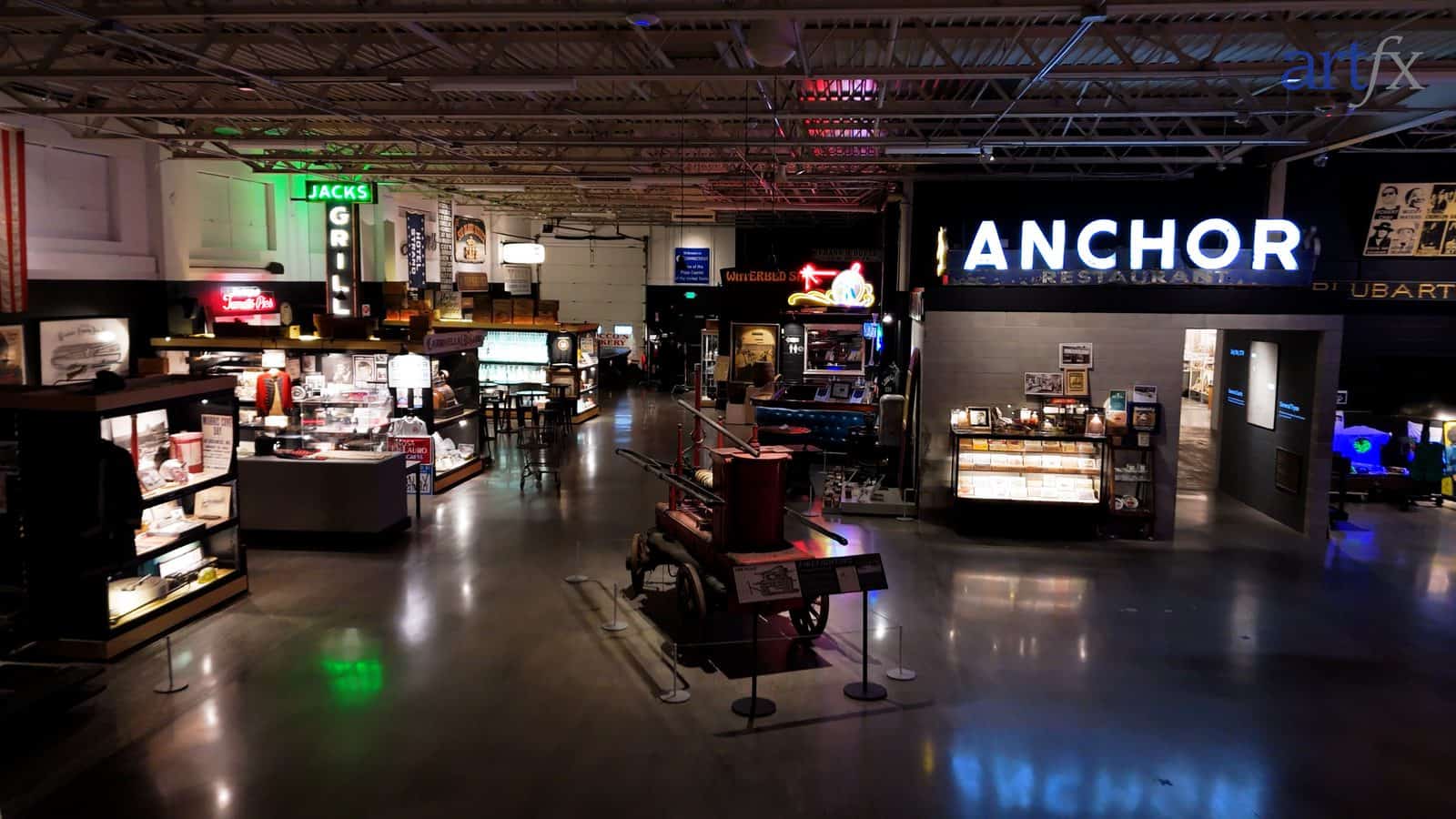
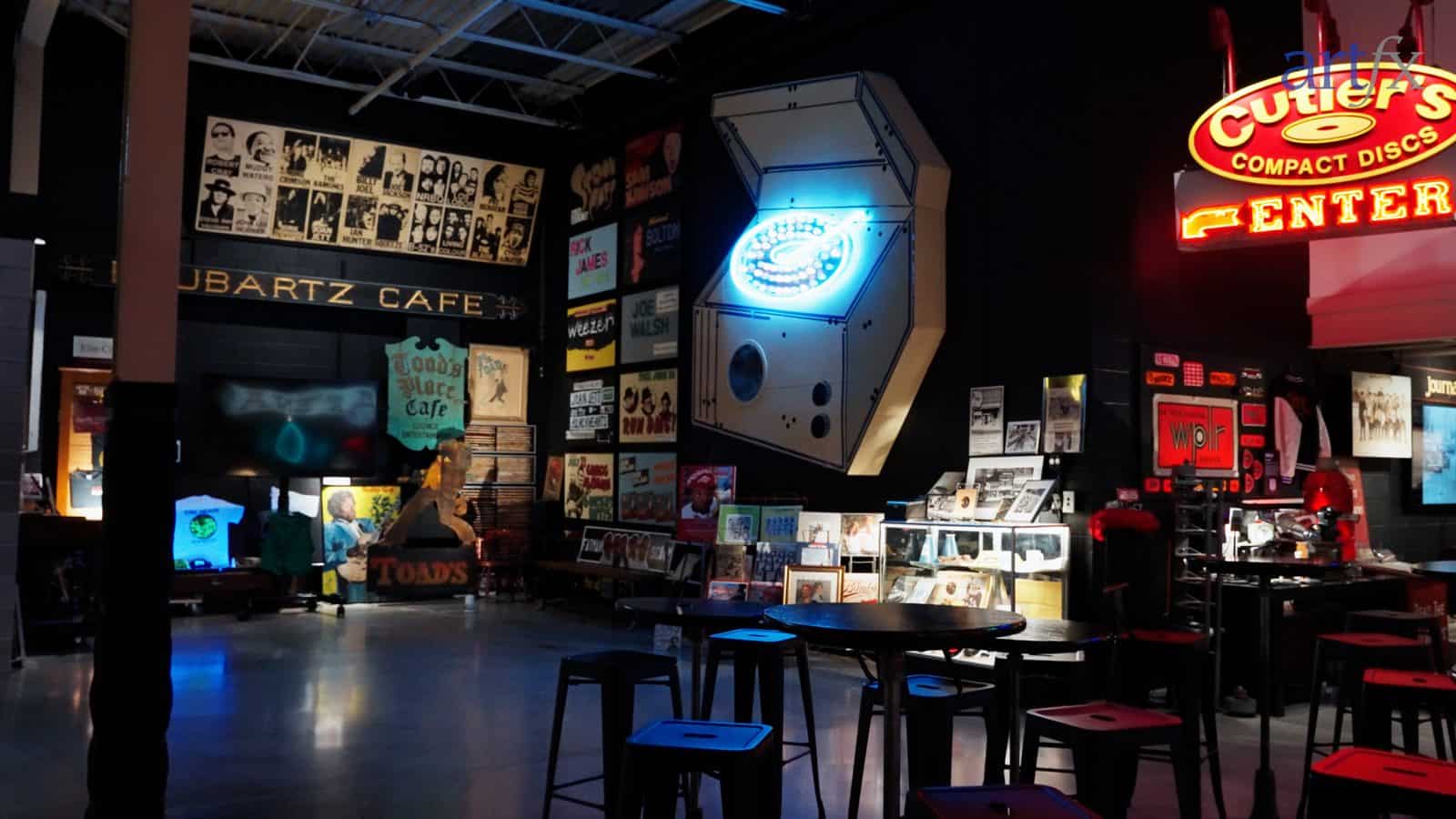
The sign out front is only the entrance. Inside, the museum is a dense, layered collection, and as it grew, Robert kept finding historic signs that needed rehabilitation. ARTfx has restored and rebuilt those pieces, from neon to channel letters, so they read on the floor the way they were meant to when they were new. Robert’s go-to is Dan, who he describes as the person who comes up with the solutions, with Lawrin backing the harder calls. The through-line, in Robert’s telling, is that ARTfx never says a thing cannot be done. They treat it as a challenge and then solve it.
“They give my talent the ability to be real. They are making this room a magical room, and it’s because of them. I could never have had another company do what these guys are actually doing for us at Lost in New Haven.”
Robert S. Greenberg — Founder & Executive Director, Lost in New Haven
See the Work
Project Credits
Client: Lost in New Haven, 80 Hamilton Street, New Haven, CT
Founder & Executive Director: Robert S. Greenberg
Signage & Fabrication: ARTfx
If you are an architect, designer, or institution with a brief that other shops call impossible, that is the work ARTfx is built for. Design, fabrication, and installation, under one roof since 1983.
Not ready yet? See how we brought the Berkshires inside at the Greylock Glen Outdoor Center.

Rhode Island’s I-95 Gateway: Two 102-Foot Signs at TF Green Airport

The ARTfx Observer | July 2024
As a key part of a $12 million beautification project, two identical 20-foot tall, 102-foot long monument signs now sit alongside Interstate 95 in Warwick, Rhode Island, marking the gateway to TF Green International Airport. One faces the northbound lane. One faces the southbound lane. Each required approximately 2,400 hours to complete.
For drivers, the signs are the moment Rhode Island officially welcomes them. For ARTfx, they are one of the largest gateway monument projects we’ve ever delivered. Roughly 4,800 hours of design, engineering, fabrication, and installation across two structures that have to look identical and perform identically against the same weather, the same headlights, and the same volume of traffic on one of the busiest stretches of highway in the Northeast. The short video below walks through the build.
Project Specs
Location: Interstate 95, Warwick, Rhode Island
Sign count: Two identical structures (one northbound, one southbound)
Dimensions: 20 ft tall x 102 ft long, each
Labor: Approximately 2,400 hours per sign (~4,800 hours total)
Project context: Part of a $12 million state beautification initiative
What a Gateway Sign Has to Do
A sign that sits beside an interstate has a different brief than a sign that sits in front of a building. Drivers see it for two or three seconds, often at sixty-plus miles per hour, in every weather condition the Northeast can produce. The brand identity has to read at a glance. The architecture has to look intentional from a quarter mile away. And the structure has to survive twenty-plus years of high-velocity wind loads, freeze-thaw cycles, and the constant vibration of nearby traffic.
At 102 feet long and 20 feet tall, these are not signs. They are small buildings. The engineering effort is closer to a piece of infrastructure than a piece of signage, which is exactly why the project required the engineering team at BL Companies working alongside ARTfx’s in-house fabrication engineering.
Two Identical Signs, Two Directions
Building one massive sign is hard. Building two identical signs that stand at different sites and have to read as one coordinated gateway is harder. The structures, the lettering, the lighting characteristics, and the landscape integration all had to match across two separate installations on either side of the highway.
From a driver’s perspective, that consistency is invisible by design. You see “Rhode Island” and “T.F. Green International Airport” rendered the same way, lit the same way, framed by the same landscape strategy, whether you’re heading toward Providence or toward Connecticut. From the fabrication floor, that consistency is a deliberate quality control discipline maintained across every cut, weld, paint pass, and lighting calibration.
Why This Project Took a Team
Infrastructure-scale signage doesn’t get delivered by one company in isolation. The Rhode Island Department of Transportation set the brief and the standards. Manafort Brothers Inc. served as general contractor. BL Companies and ARTfx shared the engineering load. ARTfx handled fabrication and installation across both sites.
Beyond the named partners, there’s the team you don’t see in the credits: the ARTfx administrative coordinators who kept the schedule on track across a 4,800-hour build, the fabrication crew who held tolerances at scale, and the installation team who set 20-foot tall structures alongside live highway traffic. A project like this is the sum of every one of those roles being executed at a high level.
Project Credits
Client: Rhode Island Department of Transportation
General Contractor: Manafort Brothers Inc.
Engineering: BL Companies / ARTfx
Photography: Peter Brown
Fabrication & Installation: The full ARTfx administrative, fabrication, and installation team
ARTfx thanks Manafort Brothers Inc., the Rhode Island DOT, and most of all, our talented administrative, fabrication, and installation staff for their dedication.
Whether your project is a single facade sign or a multi-structure highway gateway, ARTfx delivers design, engineering coordination, fabrication, and installation under one roof.

Bringing the Berkshires Inside: The Greylock Glen Exhibit

The ARTfx Observer | October 2024
Over the past summer, ARTfx teams frequently found themselves in the Berkshire Mountains of western Massachusetts. Based on a recommendation from expert interior consultants, Workroom Design Studio of Northampton, ARTfx collaborated with the Town of Adams and the Berkshire Regional Planning Commission to create a large-scale, environmental exhibit in the newly built Greylock Glen Outdoor Center.
The whole exhibit, from concept to installation, came together in six months. Donna Cesan, the Town of Adams’ Greylock Glen Project Lead since 2004, walked us through what the collaboration was actually like.
The Building
At 3,489 feet, Mount Greylock is the tallest peak in Massachusetts, and is now home to an impressive visitor and educational center at its base. Designed by Vermont Integrated Architecture and built by Soulière & Zepka Construction, the building is designed at net zero and meets LEED standards.
The carbon-neutral structure features sustainable Glulam timber and air-source heat pumps, while framing stunning views of the mountain. Its south wing houses the ARTfx exhibit, which presents educational information on local biodiversity, native plants, geography, and more.
What We Built
ARTfx design illustrator Pete Stockmal and owner Lawrin Rosen planned the exhibit for innovative construction by ARTfx fabricators, graphics experts, and installers. The exhibit covers six distinct elements working together as a single visitor experience.
Custom Printed Wallpaper
Large-scale environmental imagery wrapping the exhibit’s interior surfaces, anchoring the visitor in the landscape outside.
Informational Kiosks
Standalone interpretive stations that translate complex educational content into compelling visual storytelling.
Image Collages
Layered imagery sequences that move visitors through topics on biodiversity, native plants, and Berkshire geography.
Sculptural Trees
Structural columns reimagined as trees inside the gallery, blurring the line between architecture and exhibit.
Printed Floor
Custom floor graphics extending the immersive landscape down to ground level. The exhibit reads as a continuous environment, not a set of panels.
Illuminated Bird Sculpture
The piece-de-resistance: a one-of-a-kind ceiling sculpture featuring life-sized acrylic cutouts of the Berkshires’ most notable birds.
“With ARTfx, we had an experienced subject matter expert by our side. Through their attention to detail, they translated our ideas and complex content into compelling visuals. We appreciated their collaborative approach, and willingness to entertain multiple viewpoints, as well as their ability to adhere to our tight budget and schedule. The striking exhibit delivered by ARTfx demonstrated an effort above and beyond all expectations.”
Donna Cesan — Special Projects Manager, Town of Adams, MA
Six Months, One Partnership
In the video above, Donna talks about a real concern most municipal projects face: budgets are tight, timelines are tighter, and a small client wonders whether a fabrication partner with national-scale work will treat the project with the same care it gives bigger accounts.
Her takeaway, in her own words, was that the team made the Town of Adams feel like a million-dollar client. ARTfx handles design and build under one roof, which mattered for a six-month exhibit timeline where there was no room for handoffs between separate firms. The same team that planned the structural trees, the printed floor, and the bird sculpture also fabricated and installed them.
That single-team continuity is part of why the project stayed on schedule. It’s also why the finished space feels coherent rather than assembled from independent components.
Bringing the Outside In
The illuminated ceiling sculpture is the moment most visitors stop and look up. Life-sized acrylic cutouts represent the bird species native to the Berkshires, the same species a visitor might spot stepping back outside the building.
Donna calls out the move directly in her interview: “It kind of brings the outside in. It’s part of the environmental education focus of this structure.” That’s the whole brief in one sentence. The exhibit isn’t a substitute for hiking the mountain. It’s a way to make the mountain legible before, during, and after the visit.
Project Credits
Owner: Town of Adams, MA + Berkshire Regional Planning Commission
Building Architect: Vermont Integrated Architecture
General Contractor: Soulière & Zepka Construction
Interior Consultant Recommendation: Workroom Design Studio of Northampton
Exhibit Design Lead: Pete Stockmal, ARTfx
ARTfx Owner: Lawrin Rosen + the full ARTfx fabrication, graphics, and installation team
Whether you’re planning a visitor center exhibit, a museum installation, or a fully integrated educational space, ARTfx covers design, fabrication, and installation under one roof.
A Wayfinding System for 2,000 Acres: Oglebay Park, Wheeling WV

The ARTfx Observer | November 2024
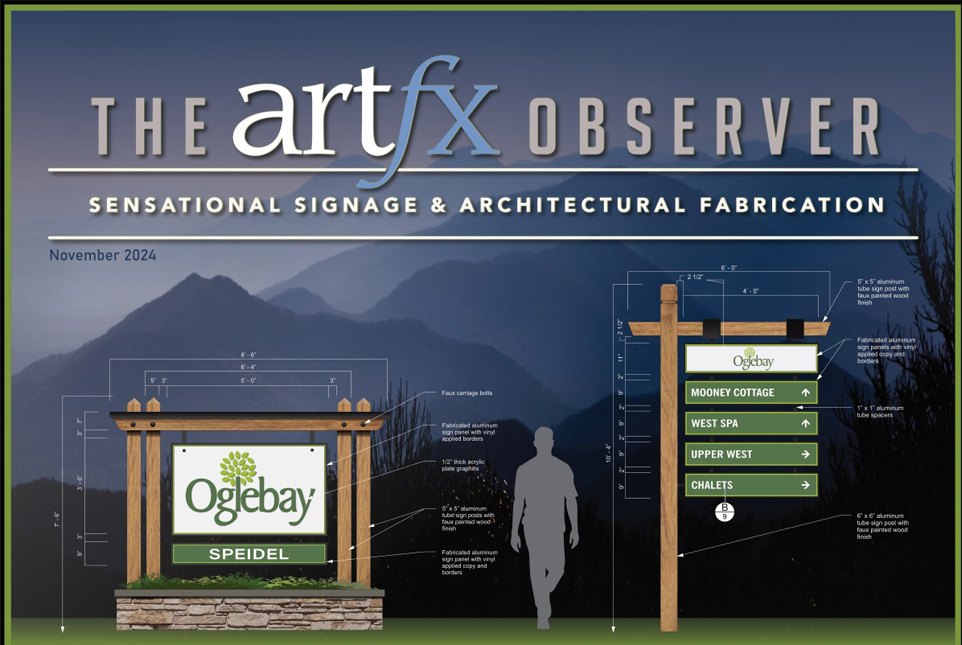
With a reference from LDL Studio, the management at Oglebay selected ARTfx to design and fabricate a new sign system at their 2,000-acre municipal park in Wheeling, West Virginia. The signs, constructed entirely of sturdy aluminum plate and layered composite, feature a faux painted wood grain to match black walnut.
A 2,000-acre park is a wayfinding problem disguised as a brand problem. Visitors need to navigate to chalets, cottages, restaurants, a zoo, a spa, conference centers, and dozens of other destinations spread across forested terrain. Every sign has to do brand identity work and directional work at the same time, in every season the park is open.
Why Aluminum That Looks Like Wood
A park setting wants the warmth of natural wood. Real wood, in this application, doesn’t want to cooperate. It rots, twists, splits, fades, and demands constant refinishing in the kind of weather Wheeling sees year-round. Multiply that maintenance across hundreds of signs scattered across 2,000 acres and the operating cost climbs fast.
The Oglebay signs are built entirely from aluminum plate and layered composite. That gives them the structural rigidity, weather resistance, and dimensional stability of metal. The faux painted wood grain finish, matched to black walnut, gives them the visual warmth of timber from any reasonable viewing distance.
In other words, the park gets the look it wants and the maintenance schedule it can actually live with. The tradeoff is one most parks, resorts, and outdoor properties eventually face. Composite signage that mimics natural materials is rarely just a budget choice. It’s a longevity choice.
Across the Park
The system covers a full menu of destinations: the Speidel golf course, Mooney Cottage, the West Spa, Upper West, the Chalets, Cottages and Shelters, the Schrader Center, the Good Zoo, the Crispin Center, and the Lakeside Entrance. Each gets its own treatment within the same visual family.
Anchor signs at major entry points carry the full Oglebay brand expression with stone-clad bases and prominent wordmark. Wayfinding totems route visitors deeper into the property, with destination panels stacked vertically and clear directional arrows. Building identification signs at individual venues use the same finish palette to pull each piece into the unified system.
The visual language stays consistent from the parking lot to the cottage door. Visitors don’t have to relearn the system every time they encounter a new sign.
“The signs designed and installed by ARTfx have transformed the look and feel of our park and resort businesses. From design to wayfinding and installation, the ARTfx team has performed at top levels throughout the process. Thank you to the team.”
Bob Peckenpaugh — President & CEO, Oglebay
Design, Fabrication, Installation
Oglebay is the kind of project that benefits from one team owning the entire arc. ARTfx handled the design refinement coming out of LDL Studio’s reference, the fabrication of every aluminum and composite element, and the installation across the full 2,000 acres. One vendor, one accountability chain, one consistent finish standard from the first sign to the last.
For destination properties at this scale, that’s not a luxury. It’s how the system actually gets installed correctly within the timeline the property needs.
Whether you’re planning a wayfinding system for a park, resort, campus, or municipal property, ARTfx delivers design, fabrication, and installation under one roof.
A Tale of Two Cities: Hartford and New Haven Sign Projects

The ARTfx Observer | December 2024
While over the past 42 years we’ve installed signs in nearly every corner of the United States, a large portion of our work can be found right here in our home state of Connecticut. This month, we’d like to highlight two exciting new projects in Hartford and New Haven.
The two projects couldn’t be more different. One is a high-tech interactive information center for the state’s largest convention venue. The other is a sculptural sign for a museum dedicated to the city’s strangest, most beloved cultural ephemera. Both happened forty-five minutes apart on I-91.
Hartford: Connecticut Convention Center
In downtown Hartford, the Connecticut Convention Center now boasts a custom 14-foot-tall, 20-foot-long information kiosk that houses ten interactive LCD touch screens. The new information center features granite countertops and ADA-compliant legibility throughout, bringing big style to the little state’s capital.
Above the kiosk, a high-resolution 10-foot by 10-foot electronic message center sits on the adjacent wall, anchoring the space and giving event organizers a flexible, high-impact display for digital programming, wayfinding, and seasonal messaging.
Project Specs
Kiosk dimensions: 14 ft tall x 20 ft long
Interactive surface: 10 LCD touch screens
Surfaces: Granite countertops
Accessibility: ADA-compliant legibility
Message center: 10 ft x 10 ft high-resolution electronic display
New Haven: Lost in New Haven
Forty-five minutes south, on Connecticut’s southern shoreline, New Haven is getting an exciting new museum. Opening in 2025, Lost in New Haven is a one-of-a-kind collection of ephemera, oddities, trinkets, and signs all related to New Haven’s storied history.
ARTfx brought a client-designed logo into three dimensions. The signature element is a 4-foot-long glowing map pin that juts diagonally outward from the building, emphasizing the museum’s local focus and highlighting the playfulness of this cabinet of curiosities.
The result is a sign that does double duty as a piece of public art. From a distance it reads as a giant map pin landing on the actual city of New Haven. Up close, it’s a finely detailed dimensional logo glowing against a dark facade. Exactly the kind of brief that makes architectural fabrication interesting.
A Connecticut Story
Forty-two years of national project work has taken ARTfx to Boston, New York, Las Vegas, Los Angeles, and dozens of cities in between. But the projects in our home state still hit differently. We drive past these signs. Our neighbors visit these venues. The work shows up in our daily routines, not just our portfolio.
Hartford and New Haven represent two extremes of what architectural signage can do. One is a polished, high-tech information system serving thousands of convention visitors. The other is a sculptural sign that tells you, instantly, that the museum behind it is going to be fun. Different briefs, same craft, both right here in Connecticut.
Whether your project calls for an interactive convention center kiosk or a sculptural museum sign, ARTfx covers design, fabrication, and installation under one roof.

Sign IDs for RISD: A Campus-Wide Identity Refresh

The ARTfx Observer | January 2025
When Rhode Island School of Design recently updated their “identity framework,” Roll Barresi & Associates, a renowned environmental graphic design firm, recommended ARTfx for constructing and installing the new campus signage. As artisans, we were honored to work with one of the world’s preeminent art and design schools.
RISD’s new glossy accent color, PMS 294C blue, stands out dramatically on satin black aluminum signs, fabricated with passionate precision for generations of art and design students to come.
The Brief
A campus signage refresh at an institution like RISD is not a single sign. It’s a system. Buildings, wayfinding pylons, museum markers, public safety identification, window vinyl, and dimensional wordmarks all have to read as one coherent visual program while solving completely different problems on the ground.
Roll Barresi & Associates owned the design language. ARTfx owned the build. Our role was to translate the new identity framework into physical signs that survive New England weather, foot traffic from thousands of students each day, and the design scrutiny you’d expect at a school where students are training to design exactly this kind of thing.
Across the RISD Campus
The program covered six distinct sign categories, each fabricated to match the new identity standards while solving its own functional brief.
Dimensional Wall Signs
Large-scale “Rhode Island School of Design” wordmarks fabricated to mount cleanly against historic brick facades. Anchor identification for the campus’s flagship buildings.
Wayfinding Pylons
Freestanding directional signs guiding students and visitors between buildings. Built to align with the new identity color palette and visual standards.
Building Identification
Building ID plates for venues like Thompson House at 62 Angell Street and Washington Place at 62 North Main Street, executed at consistent proportions across the campus.
RISD Museum
Museum identification and exhibition markers carrying the refreshed identity into one of the most visited campus venues. Public-facing, durable, and brand-aligned.
Public Safety Signage
Pole-mounted public safety identification, including the RISD shield, deployed at locations where high visibility and rapid recognition matter most.
Window Vinyl
Storefront and lobby window applications carrying the wordmark and identity elements at building entrances. Clean application, precise registration.
The Details
The substrate of choice across the program was satin black aluminum. Aluminum gives the program weather resistance and dimensional rigidity at a weight that lets the signs mount cleanly against masonry, glass, and freestanding poles. The satin finish keeps glare under control in bright New England light without going dead-flat.
Against that satin black, RISD’s new accent color, PMS 294C blue, reads as a glossy, deliberate signal element. The contrast does the heavy lifting: confident, institutional, and unmistakably RISD from across the courtyard.
Why Institutional Signage Is Its Own Discipline
Commercial signage usually has one job: get attention and convert. Institutional signage works differently. It has to communicate identity quietly, hold its character for decades, and integrate into buildings that may pre-date the brand by a century. Every plate has to look like it belongs to the same family without flattening the variety of contexts it lives in.
For a school of art and design, the bar is even higher. The audience is trained to notice typography, proportion, finish, and detail. The signage isn’t just wayfinding. It’s part of the curriculum, just by being there.
Project Credits
Sign Design: Roll Barresi & Associates
RISD Identity: Gretel / RISD Marketing & Communications
ARTfx Project Manager: Gregg Reed
Photography: David Silver, Derek Schusterbauer, Rob DeSalle
Museum Poster: Derek Schusterbauer
Whether you’re refreshing a campus, a corporate headquarters, or a multi-building healthcare system, ARTfx brings four decades of institutional fabrication experience to the build.
Serving 700 Restaurants Since 1983: An ARTfx Milestone

The ARTfx Observer | February 2025
In February 2025, ARTfx hit a monumental landmark: 700 restaurants served with signs, awnings, lighting, and architectural fabrication. Since January 1, 1983, our team has worked with an assortment of eateries in cities from coast to coast, including Boston, MA; New York City, NY; Buffalo, NY; Washington, DC; Wheeling, WV; Raleigh, NC; Destin, FL; Las Vegas, NV; Los Angeles, CA, and many more.
Restaurants are a unique signage challenge. Brand identity has to read at a glance from the sidewalk, hold up under late-night lighting and weather, and survive constant menu refreshes, ownership changes, and brand evolutions. Forty-two years in, we’ve seen every version of that challenge.
A Sample of the 700
Picking 14 restaurants out of 700 is impossible to do fairly. These are simply a few of the projects that capture the range, from the early independents that helped put ARTfx on the map to recent national hospitality brands.
| 1986 | Max on Main — an early flagship project that helped define our restaurant signage approach. |
| 1989 | The Crown — full-color illuminated identity for an upscale concept. |
| 1991 | Picasso’s — a custom storefront and signage package for an artist-themed restaurant. |
| 1996 | Soupmasters — quick-service branding that scaled across multiple locations. |
| 2003 | Jenkinson’s — boardwalk-scale exterior signage built to handle coastal weather. |
| 2005 | Hard Rock Cafe — a national brand engagement that broadened our hospitality footprint. |
| 2006 | Hush — moody, low-lit interior signage for an intimate concept. |
| 2011 | Rooftop — exterior signage and architectural fabrication for an elevated dining venue. |
| 2015 | Schnippers — multi-location quick-service signage with consistent brand expression. |
| 2016 | Addams Tavern — illuminated exterior identity with classic tavern character. |
| 2020 | Elicit Brewing Company — brewery branding from taproom to exterior pylon. |
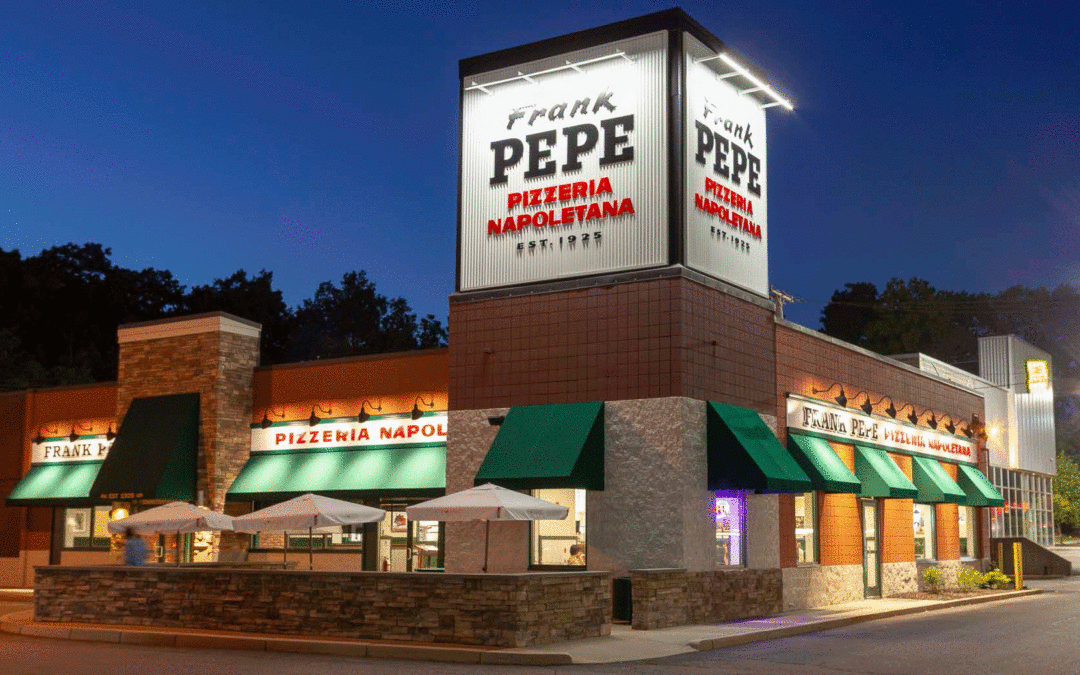
| 2021 | Frank Pepe Pizzeria Napoletana — heritage New Haven pizza brand expanding to new locations. |
| 2024 | Sally’s Apizza — another iconic New Haven pizza institution growing beyond Connecticut. |
| 2025 | Occidental — the latest project, marking the milestone year. |
Today’s Special: The DORO Group
For February 2025, ARTfx is featuring a notable local organization: The DORO Group. With locations throughout greater Hartford, Connecticut, owner Dorjan Puka has grown his enterprise from a single restaurant to eight in just fourteen years. Treva, Avert, Zohara, Casadoro, Artisanal Burger Company, and three Doro Marketplace locations are all impressively successful, each with its own brand identity and signage program.
The ARTfx team takes pride in our enduring affiliation with DORO and looks forward to the group’s continued growth. Below are the brands we’ve collaborated on.
Treva
A West Hartford staple. Refined exterior identity that fits the streetscape without disappearing into it.
Avert Brasserie
Awnings and dimensional signage that lean into the brasserie aesthetic and frame the dining experience from the curb.
Zohara
Mediterranean Kitchen. Bold typographic identity translated into clean, contemporary exterior signage.
Casadoro
Italian dining identity executed with warm illuminated lettering and a strong nighttime presence.
Artisanal Burger Company
Casual fast-fine signage that communicates quality at a glance, designed to scale across multiple locations.
Doro Marketplace
Bakery & Cafe. Three locations carrying a unified marketplace identity across distinct neighborhoods.
Why Restaurant Signage Is Its Own Discipline
Restaurant signage isn’t just commercial signage with a different logo. The work has its own constraints. The sign has to perform during dinner service in low light. It has to survive grease, weather, and the constant turnover of patio furniture and outdoor heaters. It has to anchor a brand identity that may evolve every few years through a renovation, a menu refresh, or an ownership change.
Seven hundred projects later, the lesson is consistent: the best restaurant signs aren’t the loudest. They’re the ones that carry the brand confidently from the sidewalk to the table, hold up to nightly use, and still look right ten years after install. That’s what 42 years of restaurant fabrication work teaches you.
Whether you’re opening your first restaurant, expanding to multiple locations, or refreshing an existing concept, ARTfx brings four decades of hospitality fabrication experience to every project.

42 Years of Before & After: Sign Renovation Case Studies

The ARTfx Observer | March 2025
After 42 years of architectural signage and fabrication work, the projects we’re proudest of usually aren’t the ones built from scratch. They’re the renovations. The buildings, signs, and storefronts that already had something worth saving, and that became something better because someone was willing to look closely at what was already there.
Whether you’re planning a single storefront refresh or a full-property sign system redesign, our design team and affiliated design network bring decades of value-engineering experience to the table. Our Major Contractor’s license means we own the entire arc, from concept and design through completed construction.
Here are six recent before-and-after projects that show how that approach plays out in the real world.
Six Recent Renovations
The Frame Shop
What started as a storefront refresh turned into a full architectural ensemble. ARTfx designed the new logo and fabricated the lighting, the awning, and a custom parapet frieze that transformed the building’s identity from the street up. The result reads as a single, intentional brand expression rather than signage layered onto an existing building.
Saratoga Casino & Hotel
When Architect Brian Davis and the leadership at Saratoga Casino & Hotel needed a unified sign program inside and out, ARTfx was brought in to redesign the entire system. The main roof sign drove the conversion, setting the visual tone for the wayfinding, monument signs, and interior signage that followed. A casino-scale sign program demands consistency at every touchpoint, and that consistency starts with the anchor element.
Capital Spirits
Capital Spirits had a leaky asphalt roof and a forgettable storefront. ARTfx solved both problems with one move: a new standing seam metal roof that also serves as a high-contrast background for roof-mounted channel letters. The freestanding pylon sign was shaped to mirror the store’s logo, pulling the parking lot, the building, and the brand into a single coordinated identity. Two budget items, one solution.
Iron Horse Sports Pub
Converting a carport into year-round dining isn’t a glamorous brief, but it’s exactly where value-engineering earns its keep. ARTfx designed and fabricated a four-season enclosure for the Iron Horse Sports Pub, complete with removable windows and louvres that keep air flowing in warmer months. Custom letter mounting on the new exterior tied the addition into the rest of the brand. The pub now has dining capacity it didn’t have before, built into space it already owned.
Groton Shoppers Mart
Some signs deserve to outlive their install date. The 1961 pylon at Groton Shoppers Mart carried decades of local nostalgia, and rather than tear it down and start over, ARTfx renovated the existing structure. The restored pylon anchors the property with the same character it had in the sixties, ready for another 65 years of service. Renovation isn’t always the cheapest path, but it’s often the right one.
Bloomfield Village Pizza
At Bloomfield Village Pizza, the renovation tackled identity and outdoor capacity in the same move. ARTfx designed a wash-lit dimensional sign panel that gives the storefront real presence after dark, paired with three 20-foot retractable awnings that protect the new outdoor dining patio. Customers get shade and weather coverage, the building gets a clear new identity, and the patio investment is now usable across more of the year.
How We Approach Renovation
After more than four decades, a pattern shows up in almost every successful renovation: it’s rarely about replacing what’s there. It’s about understanding what already works, what doesn’t, and what can be value-engineered into a better outcome without starting from scratch.
Our Major Contractor’s license lets us own the entire arc, from initial design through finished construction. That’s how a leaky roof becomes a brand backdrop, a converted carport becomes year-round seating, and a 1961 pylon outlives the businesses that surrounded it. The right partner doesn’t just build new signs. They look at the building first and ask what’s worth keeping.
Whether you’re refreshing a single facade or redesigning a multi-property sign program, ARTfx brings the design team, the contractor’s license, and four decades of practical experience to take a renovation from concept to completed install.
The Evolution of Neon to LED

The ARTfx Observer | May 2024
For more than a century, illuminated signs have defined the character of our streetscapes. From the buzzing glow of a corner diner to the towering spectacle of Times Square, the story of how we light up the night is one of invention, artistry, and constant reinvention.
At ARTfx, we work across every generation of this technology. Hand-bent glass neon, flexible LED neon, rigid faux neon. Each one has a place depending on the project. Here’s the story of how we got from gas-filled tubes to the signs you see today.
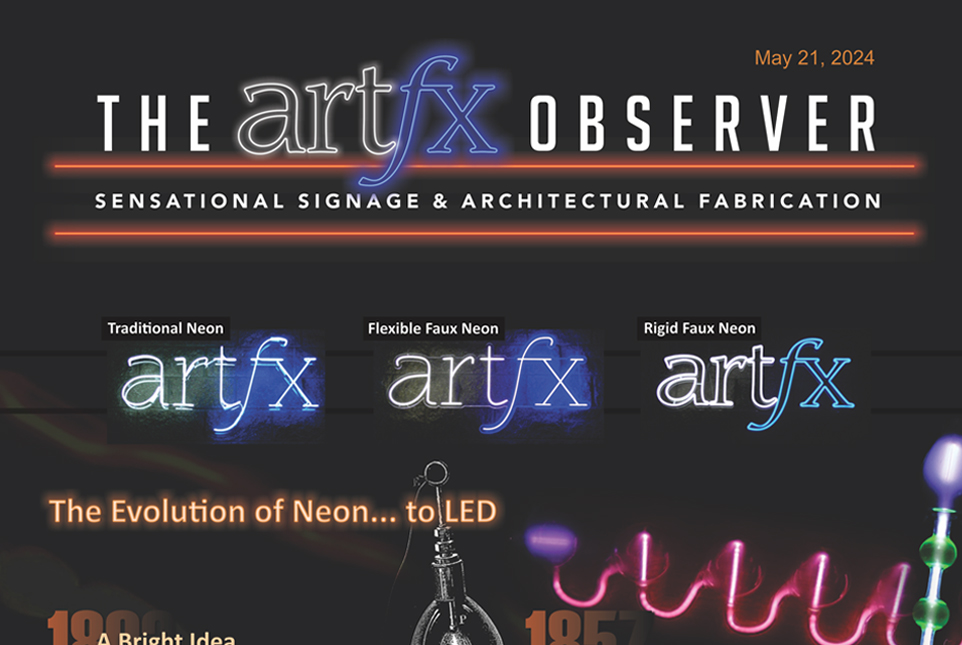
Three Ways to Get the Neon Look
Not all neon is created equal. Today there are three distinct technologies that produce the neon aesthetic, each with different strengths.
Traditional Neon
Hand-bent glass tubes filled with neon or argon gas. Prized for its warm, organic glow and the craftsmanship required to shape each letter by hand.
Flexible Faux Neon
LED strips in flexible silicone tubing that mimics the neon look. Lightweight, energy-efficient, and versatile for indoor and outdoor use.
Rigid Faux Neon
LEDs inside rigid acrylic or polycarbonate tubing. Durable, low-maintenance, and ideal for exterior signage where longevity matters most.
A Timeline of Light
The journey from the first electric arc lamp to modern LED signage spans more than 200 years. Here are the milestones that shaped the industry.
| 1802 | Humphry Davy demonstrates the first electric arc lamp, proving electricity can produce sustained light. |
| 1856 | Heinrich Geissler creates the Geissler tube, passing current through sealed glass filled with gas. Different gases produce different colors. |
| 1898 | William Ramsay and Morris Travers isolate neon gas for the first time. Its distinctive red-orange glow when electrified captures immediate scientific interest. |
| 1910 | Georges Claude displays the first neon lamp at the Paris Motor Show, proving neon tubes can produce brilliant light suitable for public display. |
| 1912 | Claude’s associate sells the first commercial neon sign to a Parisian barber. The era of neon advertising begins. |
| 1923 | Earle C. Anthony imports two neon signs from Paris for his Packard dealership in Los Angeles. They reportedly stop traffic. America’s love affair with neon is underway. |
| 1930s | Neon signs explode across America. Las Vegas, Times Square, and Route 66 become synonymous with the medium. Cities from coast to coast are transformed. |
| 1940s | World War II slows production, but the post-war boom brings a golden age. Diners, motels, and drive-ins compete for the most elaborate signs. The craft of neon tube bending reaches its artistic peak. |
| 1960s | Fluorescent and plastic signage begin to compete on cost and maintenance. Neon’s cultural dominance starts to fade, though it never fully disappears. |
| 1962 | Nick Holonyak Jr. invents the first practical visible-spectrum LED at General Electric. It emits a dim red light. Nobody imagines it will one day replace neon. |
| 1990s | Blue LEDs are perfected (earning their inventors a Nobel Prize), unlocking white light and the full color spectrum from solid-state components. |
| 2000s | LED signage goes mainstream. Lower energy costs, longer lifespan, and easier maintenance make LEDs the practical choice. “Faux neon” products emerge using LED strips to replicate the warm neon glow. |
| 2010s | Flexible LED neon tubing hits the market, making the neon look accessible where traditional glass would be impractical or code-prohibited. Rigid faux neon follows for even more exterior durability. |
| 2026 | Today, ARTfx works across all three technologies. The best sign shops don’t pick sides. They pick the right tool for the job. |
Why It Matters
Every project is different. A boutique hotel lobby might call for the warmth and character of hand-bent glass neon. A hospital wayfinding system needs the reliability and low maintenance of rigid faux neon. A restaurant patio sign might be the perfect fit for flexible LED neon that can handle weather and tight curves.
The point isn’t which technology is “best.” It’s knowing when to use each one. That’s what over 40 years of sign fabrication experience gives you.
Whether your project calls for the warmth of traditional neon or the efficiency of modern LED, ARTfx has the expertise to bring your vision to life.